

Berkshire 2026: Getting Down to Business
Abel Displays Command of the Business & Commitment to the Culture
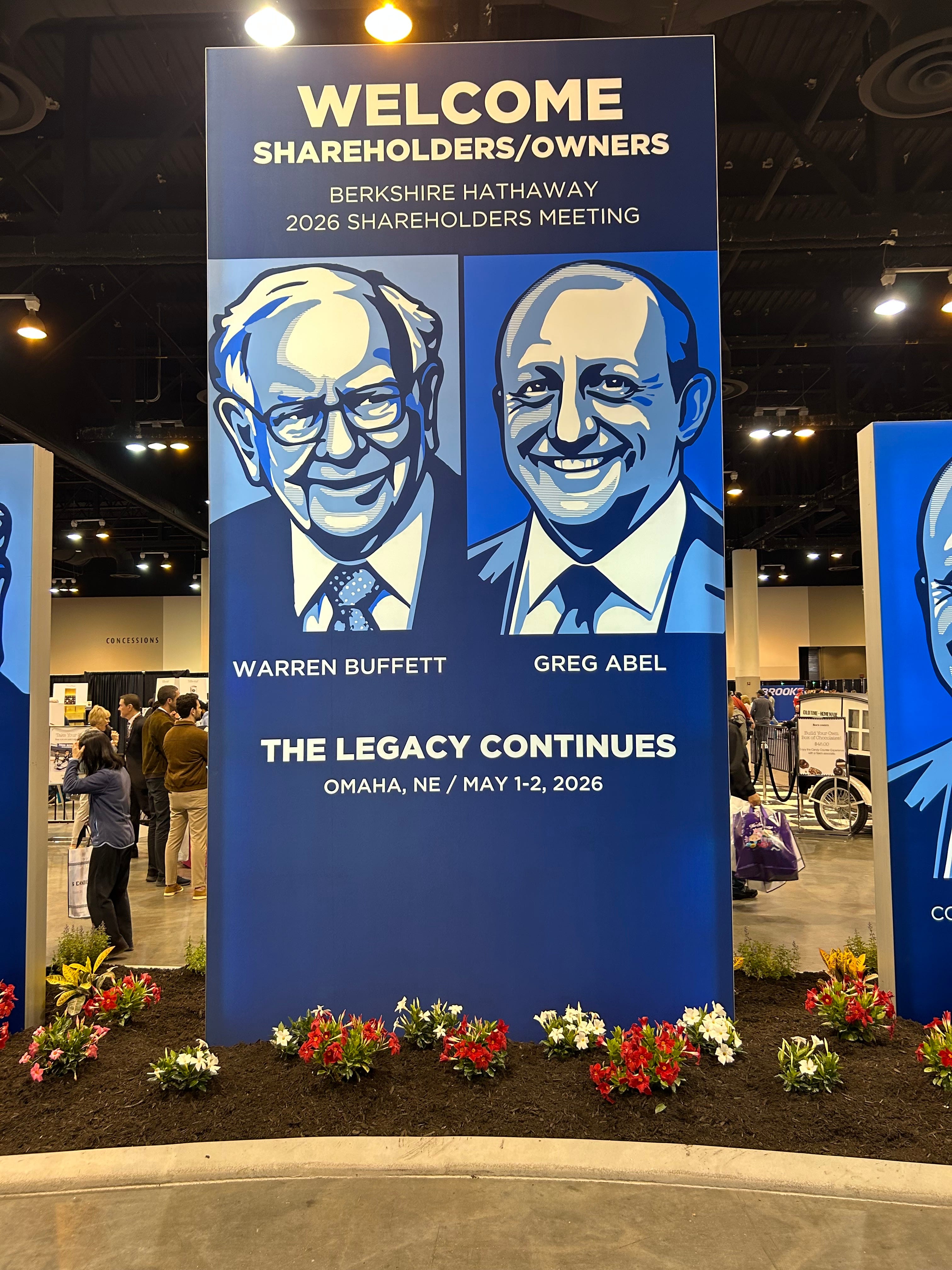
OMAHA - The first Saturday in May brings committed compounders and shareholders from all over the world to Nebraska for the Berkshire-Hathaway Annual Meeting. 2026 marks the first year with new CEO Greg Abel leading the conglomerate. Throughout the Business Review and Question & Answer Abel showed an impressive command of the entirety of the sprawling operations, commitment to the culture, and an eye for detail.
Below we offer our Top 6 Takeaways from the meeting:
Technology
Abel offered one of the most rational AI and Technology strategies I have heard from a CEO. The explanation of a “narrow AI” strategy to enhance operations and not replace human talent and judgement sets the initiatives up for more attainable success. Coming into the meeting, I was skeptical of the opportunity for further operational efficiency gains given that Abel has been overseeing the non-insurance operating businesses for many years already. Using GEICO as a model to learn, making the reinvestment decisions to prioritize technology may be game changers for many of these businesses. Abel believes that technology and AI will power the “step-change” that the BNSF railroad needs to catch up with peer operating margins.
Industrial Businesses
I stand by my observation published in Barron’s last week that Berkshire is the ultimate “HALO” (Heavy Asset, Low Obsolescence Risk) company that investors are missing. The business review segment this morning went over the industrial businesses in greater detail than any annual meeting I can remember. One notable example was Precision Castparts and IMC which are part of the global aerospace supply chain for Boeing and Airbus - two companies with estimated 10 year backlogs for their end products. One company little discussed within Berkshire, WW Steel, was highlighted as producing steel for bridges and construction projects including the Sphere in Las Vegas (which fellow HVP portfolio company Everus Construction Group (ECG) helped build). Berkshire also owns Clayton Homes, one of the largest builders of affordable homes in the US as well as other building supply companies including Benjamin-Moore paints. These are each hard to disrupt businesses.
Utility
Berkshire-Hathaway operates one of the largest utilities in the country, generating about 50% of their power from non-carbon sources. Their natural gas pipeline business touches 15% of natural gas volume in the US. In prior years Warren Buffett had been downright pessimistic on the utilities, in part due to the risks of wildfire litigation. Abel struck a more optimistic note, reminding shareholders that Berkshire is very much involved in powering data centers and well positioned for that growth opportunity. He cited Berkshire’s roughly 8% peak load coming from data centers - when competitors are hoping to get to 5%. He explained the potential to grow the data center business as a percentage of peak load by half to 12% in the coming years. Important to this discussion is Abel’s careful understanding of the regulatory compact between operators like Berkshire and the rate-payer. Operators need to earn an economic rate of return to be able to reinvest in the grid. Berkshire’s MidAmerican Energy offers prices 45% lower than the national average. Abel made clear that the hyperscalers will need to pay for their own power and that individuals should not bear higher costs for the expansion.
Japan, Inc.
Abel and insurance chief Ajit Jain offered some more details on Berkshire’s recent investment in Tokio Marine & Fire, the largest non-life insurance company in Japan. The three part deal included an investment in the company’s Tokyo listed shares, an ongoing investment in business underwritten by TM&F, and a uniquely open-ended commitment to pursue large business opportunities together.
Coupled with the investment dating back over 5 years now in the 5 Japanese “trading houses” (Mitsubishi Corp., Mitsui & Co., Itochu Corp., Marubeni Corp., and Sumitomo Corp), I am beginning to see the potential for “Japan, Inc” to continue to grow as a business/investment line for Berkshire. Many private equity firms have tried and failed to crack the Japanese market. The Berkshire culture, so strongly reiterated at the meeting this year, of being a committed, long-term investor with stable capital seems to be a very good fit with Japanese business culture. I would not be surprised in future years to hear of more Berkshire capital deployed in Japan given Abel’s comments that Berkshire will continue to build relationships in the country.
5. Owner’s Day - now with details
Greg Abel referred to today as “Owner’s Day” for Berkshire-Hathaway. Rather than try to recreate the same Warren & Charlie wit and wisdom dynamic, Abel got down to business. He walked through Berkshire’s earnings in greater detail - line by line - on the business unit level. Throughout the sessions, key businesses GEICO, BNSF, and Insurance were showcased, and two new business leaders were on stage for questions. This gave the day more the feel of a typical investor day, not simply a celebration of American business success. Berkshire will need to attract the next generation of long term individual and institutional investors. Maintaining and growing the new level of detail and disclosure in the Annual Meeting will go along way.
Stock-Picking
There has been a lot of intrigue around who would be in charge of the publicly traded portfolio at Berkshire-Hathaway. Warren Buffett’s heritage is that of an investor in public markets and the acquisition of whole businesses is something that came later. Consider GEICO which started off as a public company whose shares were owned by Berkshire, to a business which was acquired in full in 1996. Portfolio Manager Todd Combs left earlier this year to take a job outside of Berkshire. This left Abel and Ted Wechsler as the two people responsible for the $300 billion + portfolio. In discussion, Abel broke down the portfolio into the Core Holdings & long term Japanese investments which leave a more “manageable” active portfolio of about $70 billion. He made clear they are still open to opportunities in public markets and as in all other capital allocation avenues, have the cash ($380 billion) as an asset to deploy when Mr. Market makes an offer. Abel characterized the portfolio as “concentrated” - with that being a positive attribute. To that end, if we see new stock purchases, I would expect them to be fewer and larger going forward.
==============================
Recent Berkshire Related HVP Media Mentions:
Barron’s “Berkshire-Hathaway Ahead of the Annual Meeting” April 27th Print Edition
Bloomberg News “BRK/B Shares Weak Ahead of Abel’s First Meeting as CEO” April 30th
Bloomberg News “Berkshire Meeting Highlights Tough Balancing Act for Greg Abel” May 2nd.